What's your acoustic sound?
Guitar Tonewoods
The woods your guitar is made from have a profound impact upon its tone; I'll share here some of my own extensive experience of
different tonewoods, which may help you find 'THAT' guitar, which is a perfect match for your voice or playing style.
*Disclaimer* These are just my personal views, but in every case, I own or have owned a guitar made from the woods I talk about here, so it's very much experience-based, rather than merely floating random opinons.


Sinker Redwood - My Brook Tavy, 'Autumn'
It has the voice of an angel
Sitka Spruce, here on my Furch Red Deluxe GC-SR
Koa; such an exotic wood. This is my Taylor GS mini

African Mahogany, and this one is a
particularly striking top, with huge flames running the full length of the body.
This is my Taylor AD27e.
Different Woods DEFINITELY = Different Tones
Introduction
First of all, I'm not going to claim to be a guitar construction expert, though I do know something about it, having been friends with one of England's finest luthiers, Roger Williams (now retired) for many years. I even thought that I might be able to make a guitar myself at one point, but Roger (bless him) kept me on the straight and narrow, away from scary things like routers and glue! I have also learned a huge amount about tonewoods from Simon and Andy at Brook Guitars, who made two of my instruments.
What I can offer however, is a significant amount of hands-on experience of playing guitars made from a wide variety of different wood combinations, and have owned over 50 guitars in my life (I don't still have them all - honestly!). I will try to impart my knowledge over these pages, but if you have any specific questions that I don't answer here, I'll be happy to try to do that - simply email me.
I will be talking about all-solid wood guitars, in the main. Laminated guitars can be fine instruments with a solid wood top, but the tonal difference between laminated Rosewood and laminated Mahogany on the back and sides is far less profound than with solid wood, where tonal differences are often striking. The top wood, however, has by far the greatest impact upon a guitar's tone.

Walnut back - a rather dry, transparent tone, but articulate and clear. This guitar is a Sheeran by Lowden S4 that I used to own.
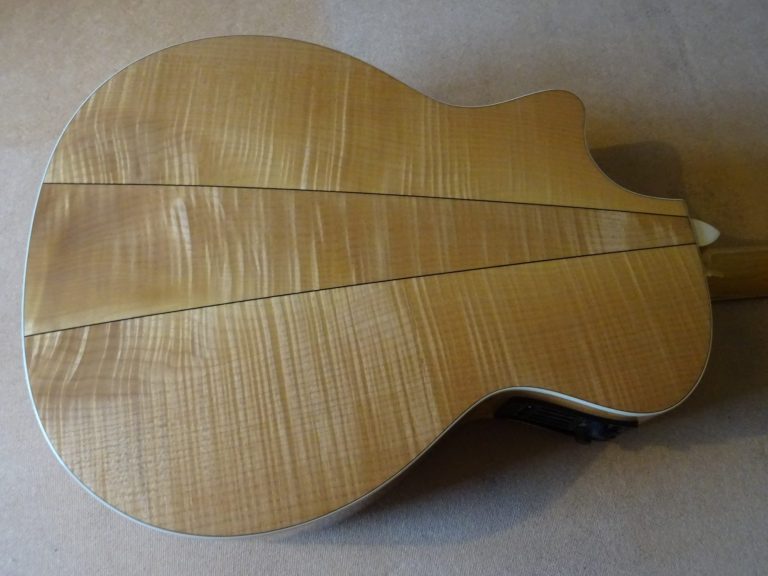
Flamed Maple - seen here on my Taylor 614ce 2000-Ltd.
Maple has a strong attack, and a short decay time, meaning that notes are punchy and clear, and cut through a mix well, if you're playing with other musicians. It is more midrange focused.
It's such a beautiful tonewood.
Let's Talk Tops
I'm not referring to T-shirts or vests - the top wood of the guitar (the side with the soundhole for those new to this) has probably 80% (opinions may differ here) of the impact when it comes to shaping the tone your guitar will produce. If you like a wide dynamic range, then the Spruce family or Western Red Cedar will give you that. Cedar slightly darker in colour, sounding full and loud right at the
beginning of your guitar's life, and whilst it may improve with age, it won't be as noticeable as the tonal changes with Spruce, which is renowned for 'opening up' with age. Some will cite pre- world war two Martin guitars as a prime example, and older guitars are often sought after because that ageing process has already taken place. It's basically a drying out of the wood, over time, which lends to a richer, more mature tone. One of my very first high end guitars was a Taylor 514c, which has a Cedar top, and is a truly wonderful
instrument for fingerstyle, with every note chiming beautifully, but it really didn't like my (perhaps heavy handed) strumming, and it quickly loses focus and clarity. I still have that guitar - it would take a lot to part me from it, even though it's one of my 'vampires' - in a coffin-like case and doesn't really see the light of day - sadly not on stage anymore.
Many guitar manufacturers now use 'Torrefication' where the wood is dried out in a kiln, to effectively 'age' the guitar woods before the instrument is built, and it can make a profound difference to the tone. This may be a new practice but it's here to stay.
Going back to the actual woods, Spruce has a higher headroom that Cedar, meaning that it can be played with a heavier attack before the notes/chords kind of trample over each other and the 'clean' tone breaks up. There a many different types of Spruce, and choice is highly subjective. Sitka Spruce is a great all-rounder, capable of delivering punchy tone which picked or strummed, and yet can be subtle and sweet for fingerstyle. Adirondack or Red Spruce has a higher headroom even than Sitka, and is prized by bluegrass players, whilst Englemann and European Spruce are more subtle and will give you a warm tone when picked lightly, though they may 'top out' (overload) if strummed heavily, though I find the Englemann on the Furch Pioneer pictured below copes really well and makes that little guitar sound huge.
Other Spruces include Dolomite Spruce, from high in the mountains, and Swiss Moon Spruce, which is cut at the precise time in the lunar cycle when the moon's gravitational pull reduces the sap in the tree, thus helping to produce a more mature tone. I owned a guitar with such a top, and it was an incredible sounding instrument; unfortunately I couldn't get on with the chunky neck it had.

Sitka Spruce - Furch Red Deluxe GC-SR
It sounds like it has a Heavenly choir on every string!

Western Red Cedar - Furch Yellow OM-CR
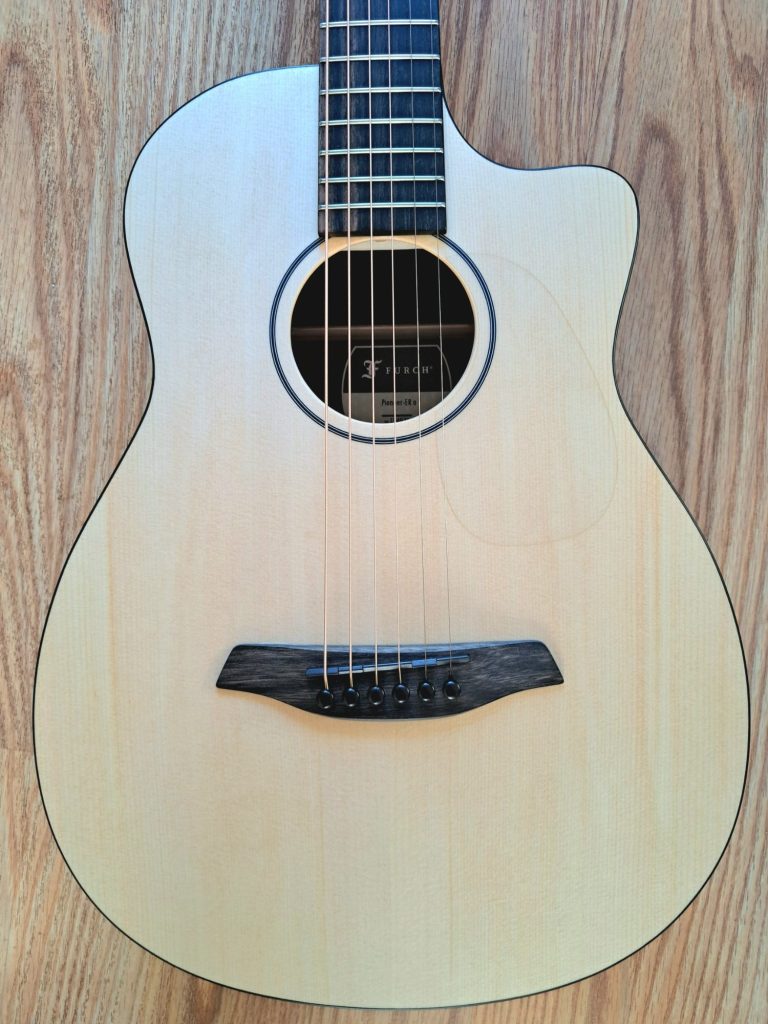
Englemann Spruce - here on the Furch Pioneer ERa; it is a remarkably warm and responsive wood
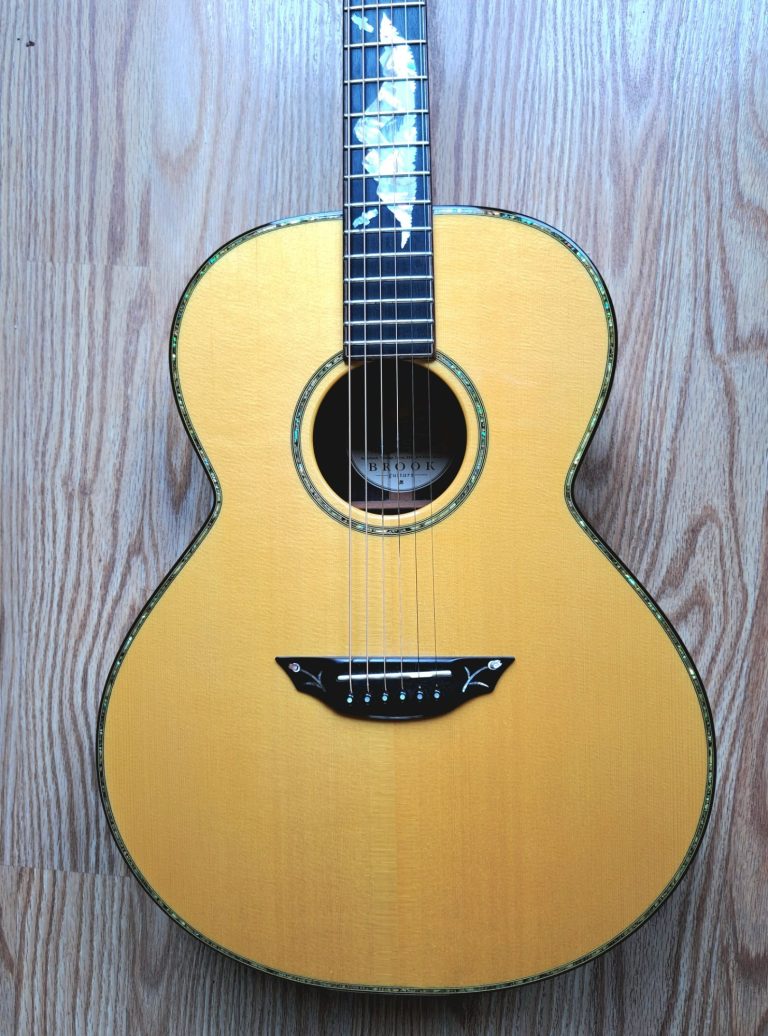

European Spruce - a softer wood than Sitka that responds well to a light touch
Sinker Redwood - my Brook Tavy, 'Autumn'
...this was during the build process...it plays a lot better now than it did then!
Sinker Redwood gets is name from the Metasequoia Redwood trees that sank to the bottom of a river after being felled, subsequently lying in the mud and silt on the river bed for many years. The wood here on my Brook Tavy 'Autumn' came from a river in Northern California, where it had laid since around the time of the American Civil War, eventually being recovered when the river was dredged late in the 20th century. The streaks you can see in what might otherwise be a fairly plain wood, are the result of the log absorbing the mud and minerals therein, effectively dyeing the wood as the water pushed it along the grain. The tree may well have been over 100 years old at the time it was felled, so in 2025 that means it could be 200 years old - truly ancient.
The tone of Sinker Redwood is highly regarded, with it typically having much of the bold openness of Cedar, with a higher headroom, so the guitar is less prone to losing focus if strummed hard. Every note on this incredible guitar sounds full and thick, with a clean attack and a long decay time. I wish I'd discovered Sinker Redwood many years earlier, as I would have had this guitar made years ago, but then maybe it wouldn't be what it is today, as other factors might have impacted on its tone or aesthetics. It's one of those times when I simply give thanks that I own this wonderful instrument, and I guess if I were ever stranded on a desert island, this would be the guitar I'd want with me.
It's a wood that works extremely well with Indian Rosewood back and sides, the depth and clarity of the Rosewood providing a rich sweetness to the tone, which I would describe as 'dark and woody'. As you can see, its visual appeal is enhanced by the contrasting abalone inlays.


Hardwood tops are a different breed altogether. The tone is very different from Spruce, and has a natural compression that can smooth out some playing imperfections; Mahogany is perhaps the most widely used hardwood top, and for many decades has been favoured by jazz and blues players, and for recording, where they are less likely to overload the signal and thus produce a reliable recorded tone. Koa - only found growing in Hawaii - is a visually striking wood that has become incredibly popular, and also has genuine compression, with perhaps less of a bass output that Mahogany and definitely far less than Spruce. I have owned a number of Koa guitars over the years, and in truth only three of them have ever given me what I wanted in terms of tone, but - confession time (!) - I bought them for their visual impact more than their inherent compression. I use mainly Mahogany or Koa guitars when recording, though on the album I am producing for 2026, I will be playing a variety of guitars - I'll list those instruments on the cover, so see if you can tell which one is which!

Mahogany - Furch Pioneer - what an incredible little tone machine this thing is!

Koa - Taylor 724ce
You can see from the images above that each wood has its own visual qualities; it is said that beauty is in the eye of the beholder, so again the aesthetics of each guitar will once again be a personal preference. Many years ago, when I began performing live, I was one of the few players around with a Larrivee all Koa guitar, and I can't recall a single night when someone didn't remark on its beauty. These days, one can see a lot of guitars with darker tops, and I do wonder whether this is because visual impact is desired more than before? I have to confess that in those days I used my striking Koa instrument almost like a shield, as my confidence was not what is has become.
I recall a night over 20 years ago, when I was support act to the late, great David Mallett. Dave and his UK agent stayed at my home overnight after the gig, and we were trying out each other's guitars - Dave had a Martin D-18 then - and he'd borrowed the Martin D-42 I owned at that time as a second instrument on stage. When he picked up my Koa, Dave's face broke into a huge grin and he said "Now this is a real front man's guitar!" When he played it though, he quickly remarked that he much preferred the wide dynamic range of a spruce top to the very compressed Koa, adding that it would be great for blues or possibly recording. Many of my later songs on YouTube were recorded with my Taylor 724ce, which is has a reliable tone - it has great stability and, surprisingly for a Koa guitar, it has a nice hard bass attack, though it's certainly nothing like any of my Spruce and Cedar instruments. It also plays very nicely so there's less chance of a dead note due to (my poor!) technique.
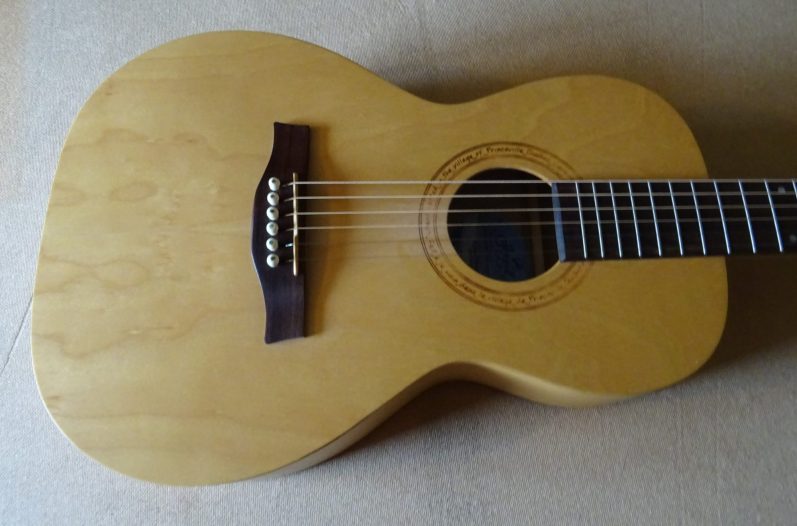
Maple comes in many forms, such as 'Big Leaf Maple', Flame Maple, Quilted Maple, Rock Maple; in essence they possess the same tonal characterstics, though visually they are very different. When used as a top, Maple can make for a surprisingly loud guitar, with significant midrange punch. I have played numerous Flame Maple topped guitars, and they all fitted this description very well; I have owned one for around 15 years - a Seagull Entorage Parlour guitar, with a Rock Maple top. The first time I played it the the store, I was astounded at how much sound came out of such a small box; it literally filled the place, and I didn't have to work hard to get a powerful attack from it. Maple is known for having a bold attack, and a shorte decay time, so it's a nice choice for a wood to cut through a mix in a band setting, and when the top is Maple, the fundamental is very strong indeed. It's a hard, dense wood, and also rather heavy, but if you want a gutare where the previous chords/notes don't sustain over the next ones - there is clear separatiion - them Maple just might be for you. I would always recommend trying before buying - as I would with any guitar - as tone is highly subjective.
Backs and Sides - how much difference do they make?
If the top wood of the guitar is effectively the amplifier, then the back and sides (principally the back, which reflects the sound waves produced by the vibration of the top) are effectively the guitar's EQ. The tonal colour that the back wood can produce should not be underestimated; I own, or have owned, all of the woods I talk about in this article, and I can honestly say that the difference sometimes is like dark and light.
Let's dive right in to the world of guitar tonewoods for the back and sides; I will begin with the two most commonly used, Mahogany and Indian Rosewood.
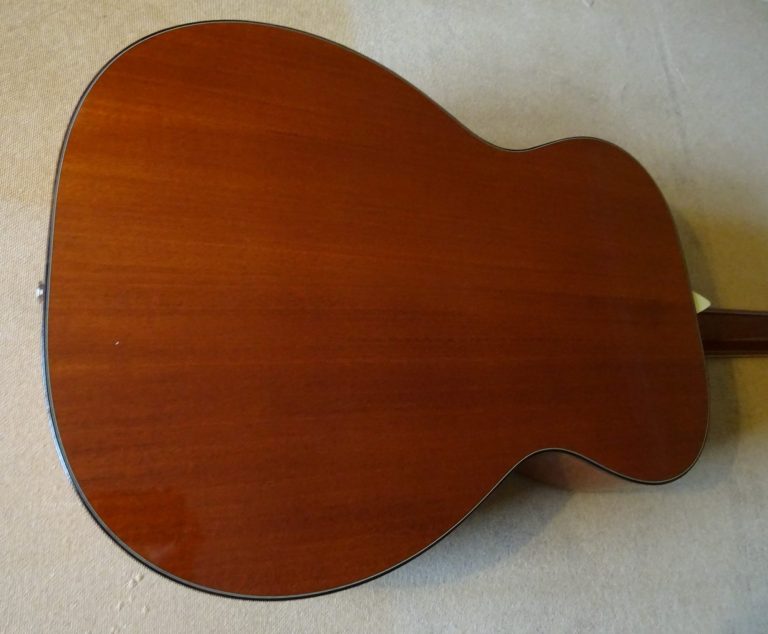
Honduran Mahogany
- on my Larrivee OM-05
African Mahogany
- on my Furch Blue OM-MM
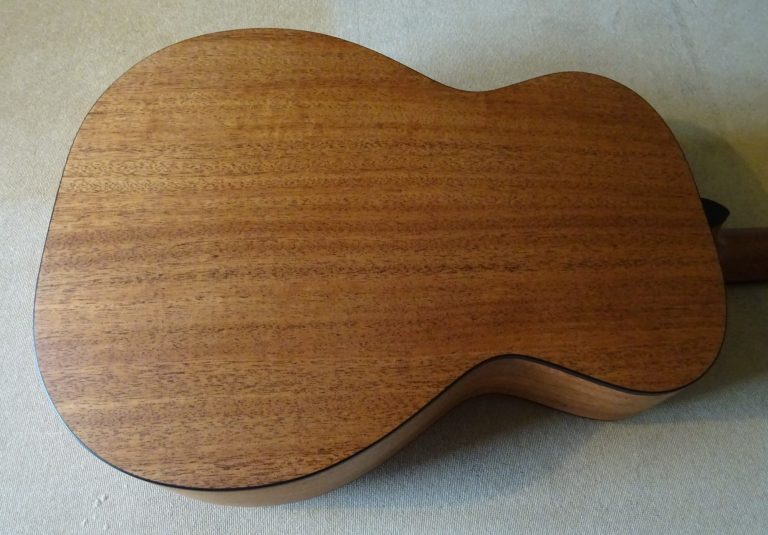
Mahogany is a versatile and very popular tonewood, with a strong midrange fundamental, but also possessing nice treble and a decent amount of bass response. This wood is often chosen by fingerstyle players due to its overall balance and clarity; no tonal range is
deficient, or overpowering. Bright and punchy, Mahogany is a good choice for cutting through a mix. Honduran Mahogany is seen as the 'true' Mahogany, with a more subtle, muted aesthetic; African Mahogany is a more affordable variety, but often has striking striped grain, and even flaming between the stripes. Tonally I feel the Honduran is perhaps a tad richer, but I parted with such a guitar for an African Mahogany one as it suited me better. Sapele is another alternative, and has a brighter tone than both Honduran and African.
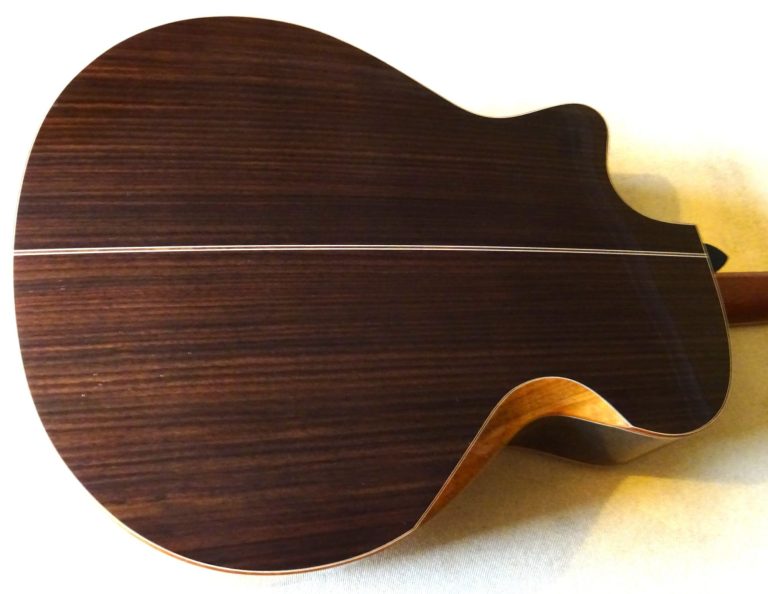
East Indian Rosewood
- on my Furch Red Deluxe GC-SR
Generally known as Indian Rosewood, this is a dense and heavy wood that has a profound bass and treble response, with a 'scooped out' midrange, meaning that it's a great choice for acoustic singer/songwriters as the human voice, being fundamentally in the midrange tonal spectrum, kind of sits in the space that Rosewood leaves. It has a very rich and deep tone, but also sparking trebles that really shine.
Maple - Flamed Maple in this case
- on my Taylor 614ce-2001 Ltd. also known
as the 'Freedom Guitar'
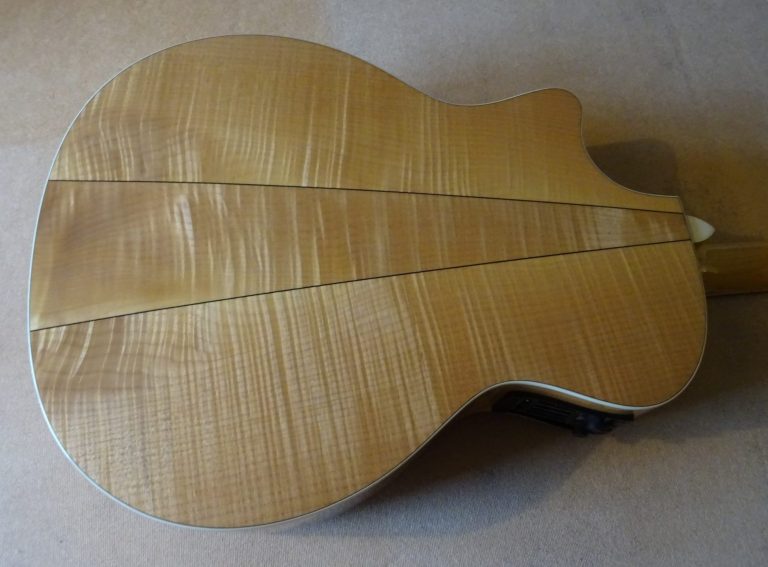
Maple is dense, hard and heavy; it has a powerful attack and a very short decay time, quite midrange to top focused, it has a bright and clean tone that really stand out in a mix/band setting. I have owned a few Maple guitars, and love what they can do, but they're not my first choice unless I'm playing with other musicians, acoustically. They are often striking looking guitars, with beautiful wood grain.
Walnut (Black Walnut in this case)
Furch Blue Baritone GC-SWa
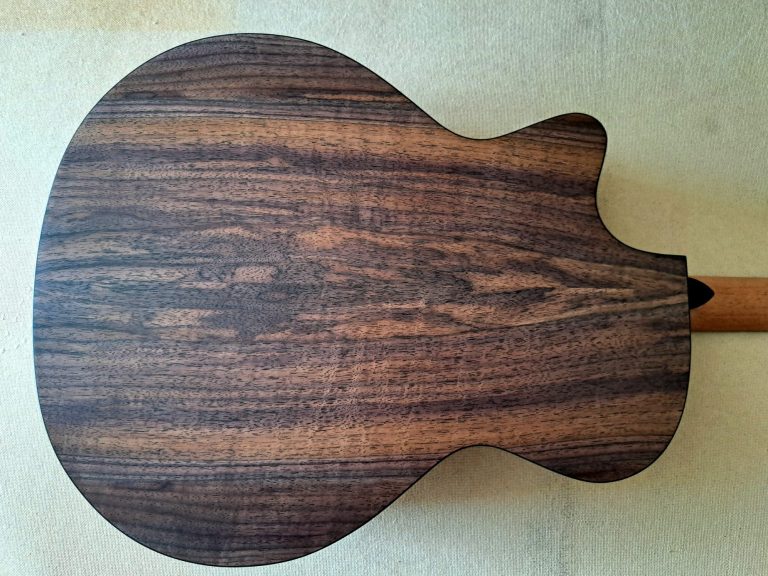
Walnut is another wood with different varieties used for guitars, including Black and Claro Walnut. It has what some describe as a
'transparent' tone, somewhat dry, but definitely clear and well balanced. My previous Walnut guitars had great tonal clarity and plenty of bass without being boomy. It works well with a Sitka Spruce or Cedar top.
Koa
My Taylor 724ce
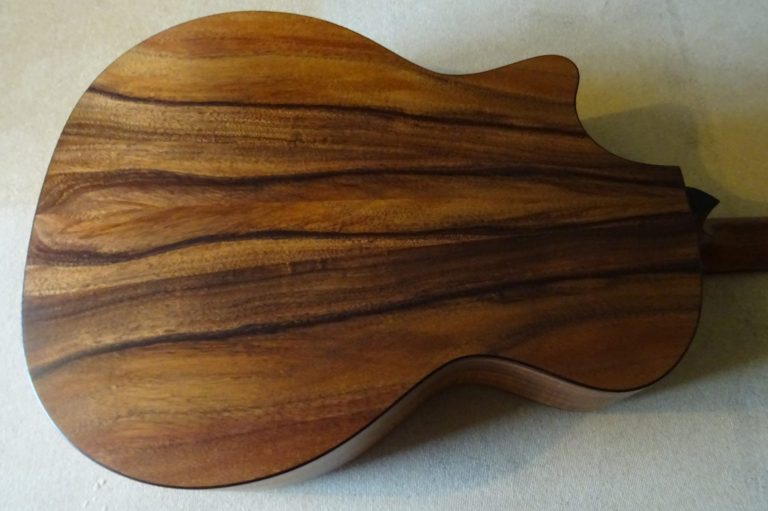
Perhaps the most visually striking tonewood, Hawaiian Koa is very midrange focused, with bright clear trebles, and generally, less in the way of bass response. It has a lovely clear tone, and is quite similar in range to Mahogany.
I spent literally YEARS searching for a Koa guitar that had a more pronounced bass, but I was also insisting on a Koa top, which made my quest considerably more difficult! A larger body size, or a shape that has a larger lower bout may help provide that - my Tacoma EKK9 and Taylor 724ce are the closest to meeting that bass requirement. All that said, Koa is am amazing wood; I can
literally feel the vibration through the back of the guitar going into my body merely when holding the guitar in a room with other music or even loud speech - it really picks up and transmits sound. When I started playing professionally, I used to play with an incredibly rare Larrivee all Koa guitar, and when waiting for my turn to showcase my music, I had my own musical chest massage!
Ovangkol
- my Taylor AD17e Blacktop
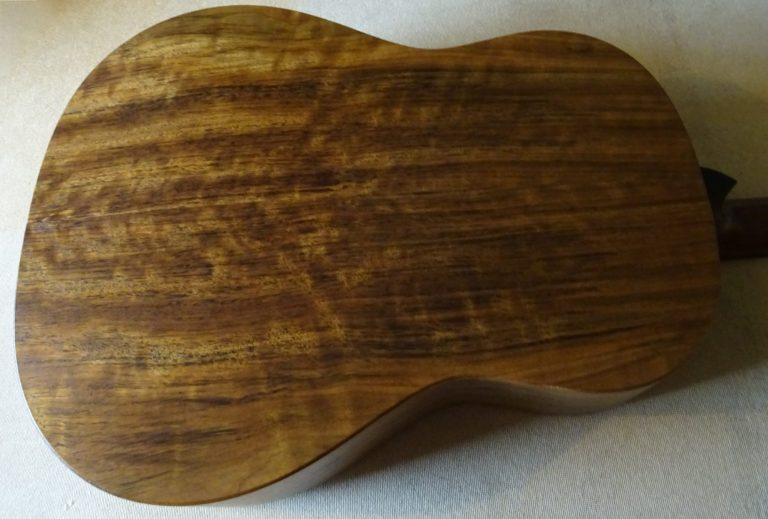
Ovangkol is, in my opinion, underused and underrated as a tonewood. It is VERY similar to Indian Rosewood, with a less 'scooped' midrange, so it's a little more balanced, and still leaves a good space for my voice. Plenty of deep bass, nice trebles, a clean and
present midrange, and wonderful flamed aesthetics (certainly in the case of my guitar) - what's not to like?
Blackwood
here on the Stuart Capuano HR-2
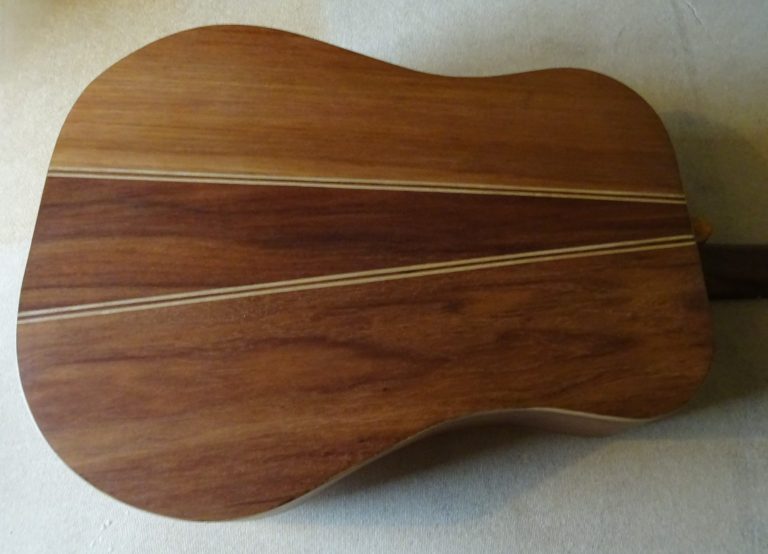
Clear, bold, with great projection, Blackwood offers another alternative to Indian Rosewood, with even more midrange than Ovangkol. I have heard some say that Blackwood has a lot less bass, but that's not my personal experience; both this guitar here and my friend's Furch Alpine Spruce /Blackwood have plenty of bass response - I would describe the low end on the HR-2 as almost scary! Blackwood is also often highly figured, a little similar to Koa; the woods used for my guitar were reclaimed from 100+ year old furniture, so they weren't originally chosen for their aesthetics, but to me they have character, and - more importantly for a musical instrument - wonderful tone.
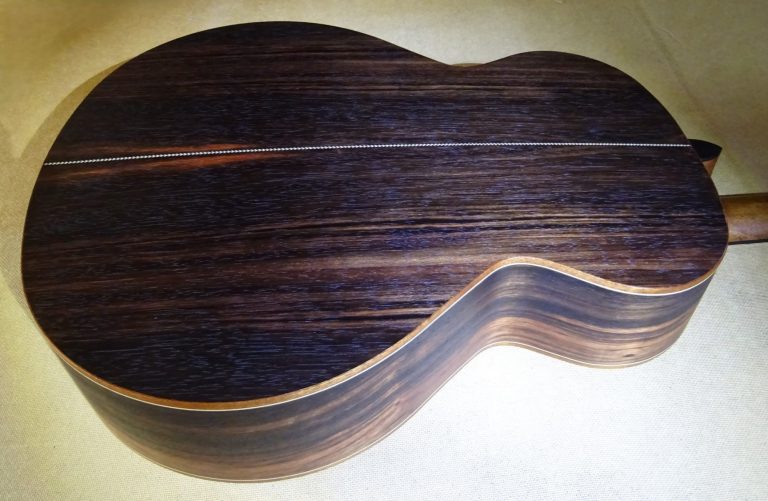
Ebony (Macassar Ebony)
My Dowina Danubius
Ebony is a very hard wood, but produces a wonderful low end growl, and still has good midrange and sweet highs; it's definitely on the darker end of the spectrum, both tonally and visually. It often has beautiful streaks of lighter, honey colouring in the grain, and in all, it's a very pleasing combination of tone and aesthetics. I actually wasn't going to include this as the Ebony on this guitar is actually layered, not solid, but WOW was I blown away when I played it for the first time - I have never played a guitar that's not made entirely of solid wood that sounds as good as this, that sounds like a great all-solid wood acoustic should sound.
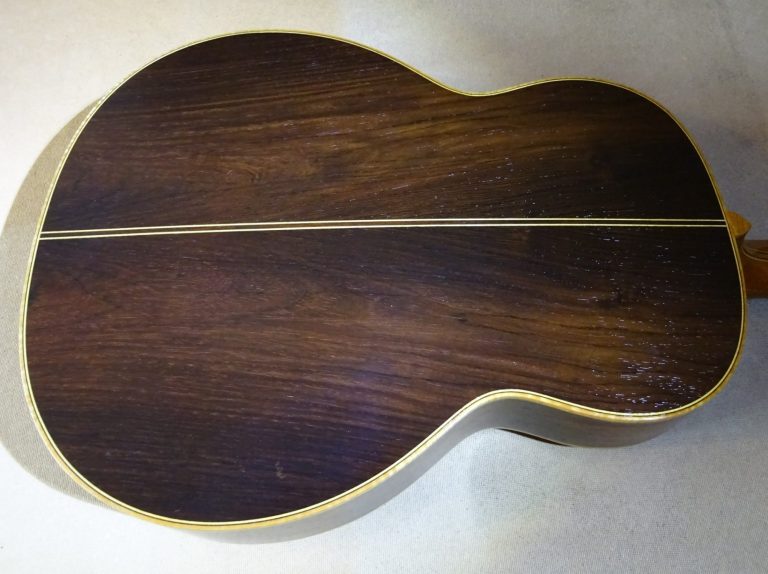
Brazilian Rosewood
(Left) My McIlroy A005 (Right) My Brook Tamar Custom
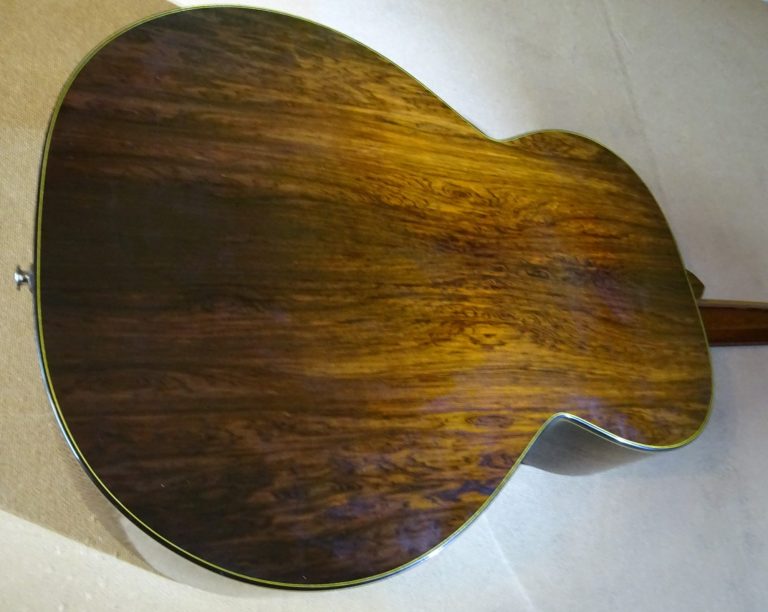
Considered by many to be the 'Holy Grail of guitar woods', Brazilian Rosewood is subject to restrictions on how it is harvested, and it has to come with CITES paperwork to evidence that the trees from which the wood was taken were not felled, rather they died and their wood reclaimed from the swamp. It is this lying in mud that often colours Brazilian Rosewood so differently; the Brook Tamar is so dark that I had to add a light source to show the grain, whereas the McIlroy is naturally a more chocolate hue. The wood is extremely dense and incredibly hard, sometimes prone to splitting, and has a bass response with a pronounced attack and long decay time.
The dynamic range is huge, with scintillating highs to balance the low end; oddly, despite these superlatives, it's not my favourite
tonewood - I find it a little too 'edgy' in its clarity; it would perhaps be a better fit for a fingerstyle player rather than a singer, but I'm just being picky!! I guess if I had my time over, I probably would have paid less (it is a VERY expensive tonewood) for a wood combination that suits my needs better.
It is also risky to travel with - quite apart from the risk of damage, there's the chance that an eagle eyed
customs official might impound the guitar until papers proving the wood's provenance could be produced; importing (smuggling,
effectively) a Brazilian Rosewood guitar could carry heavy penalties - and definitely stress that I could do without. In 2003, I took my Brook Tamar to the USA, to play a gig in Aspen, Colorado, and whilst it received high praise from the sound technician for its balance, I was risking (though I was blissfully unaware at the time) it being confiscated, and possibly myself being incarcerated.
Just in case anyone thinks this kind of thing doesn't happen,think again. In 2018, I took a risk and bought a guitar on Ebay, simply
because it was incredibly rare - my Taylor 614ce 2001 Ltd; which was made to raise funds for the families of the 9/11 firefighters who paid the ultimate price for their dedication. That guitar (featured earlier on this page) is made from highly figured Flamed Maple, yet when it arrived at Customs here in the UK, it was seized because they thought it might be made from Brazilian Rosewood. I was warned both about potentially losing the guitar permanently, and also being prosecuted for importing an illegedly illegal instrument. Huge fines and possibly a term in prison - serious business. It took three weeks and as much evidence I could get from Taylor to prove the provenance of the guitar, and for the time they kept it in storage - which was entirely the result of their ignorance - they actually sent me an invoice for the cost of said storage, totalling nearly £300! If I refused to pay, they would auction it to recover their costs -
outrageous, but true.
The moral of this tale is don't travel with a Brazilian Rosewood guitar unless you have the paperwork! I now have a Furch Little Jane, in Indian Rosewood - as my guitar for any oveerseas gigs I might play. It qualifies as carry on luggage, and plays and sounds like the
professional instrument that it is. I also get the fun element of assembling it on stage in front of my audience!
OR...maybe for Something REALLY different: how about Carbon Fibre?
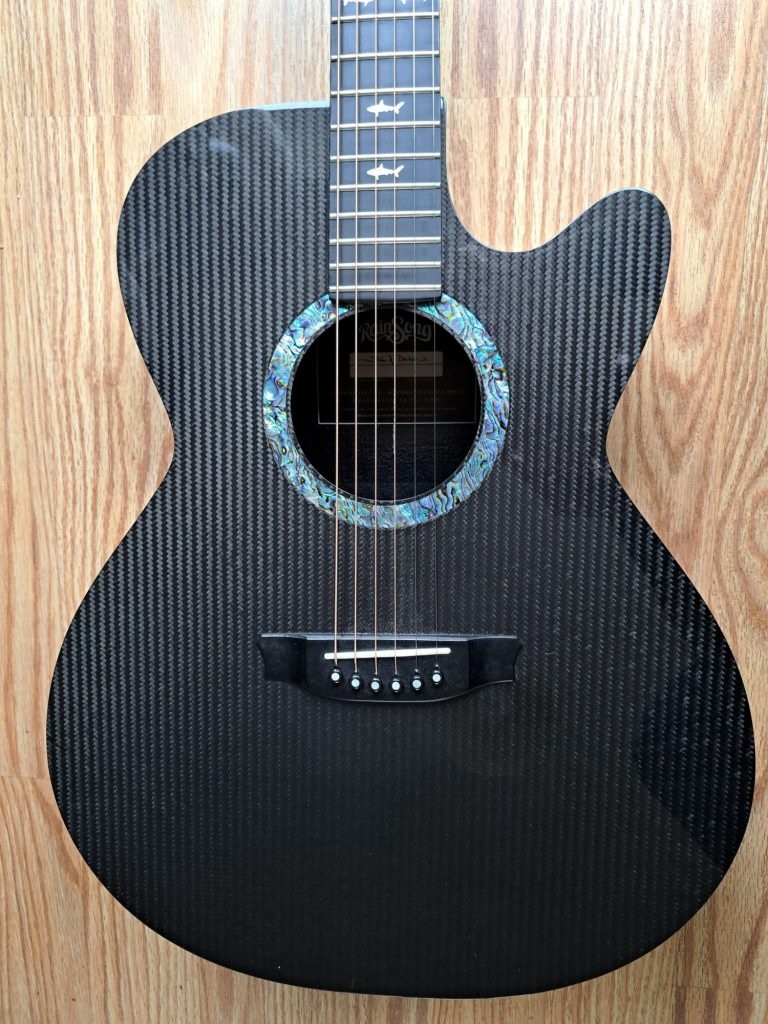
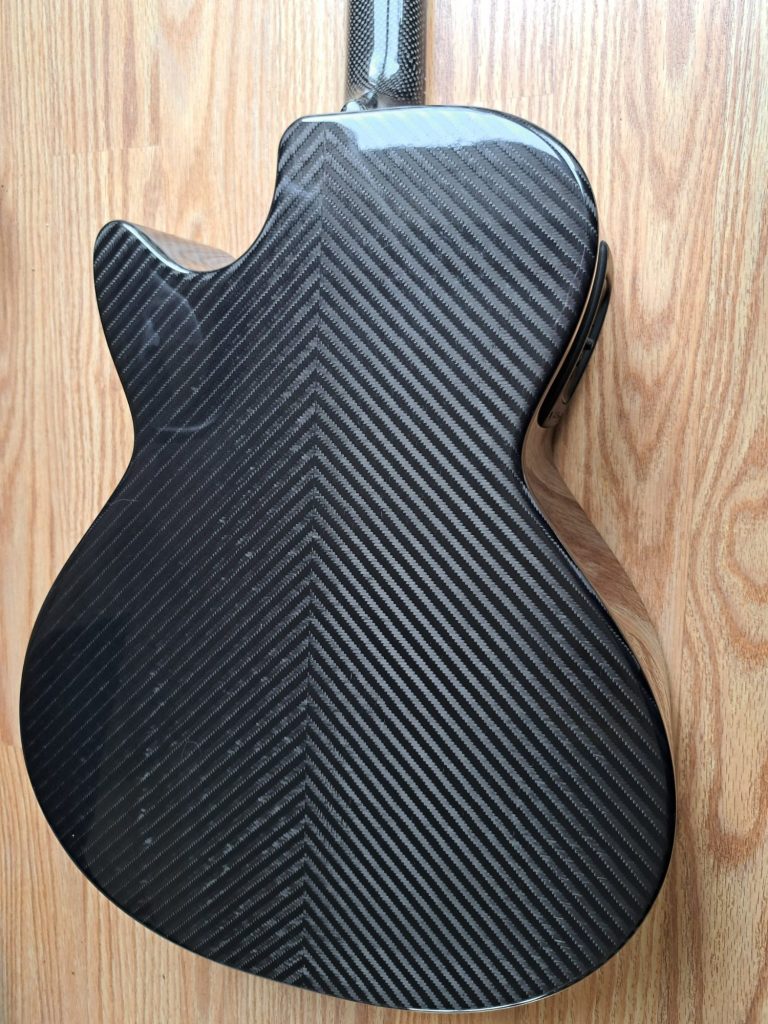
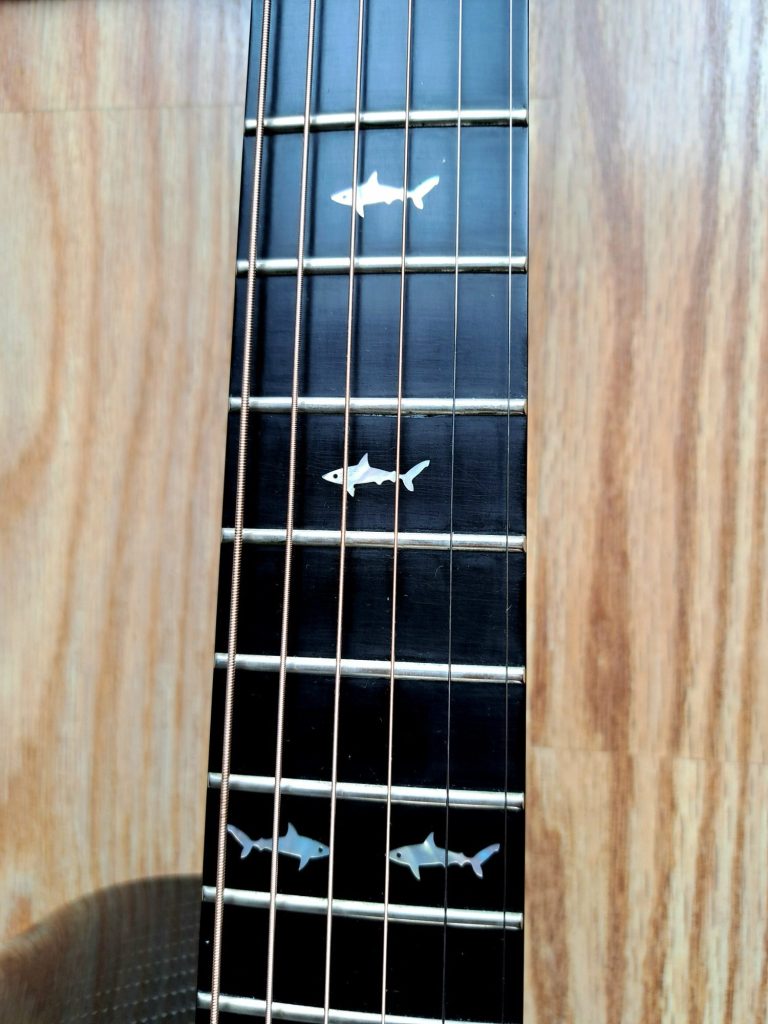
Impervious to humidity and temperature changes, ridiculously lightweight (it requires no bracing), Carbon Fibre is the answer to living or gigging in a changing environment. Its stability means that you can take it out of its case on a snowy day, into a hot room, and it will stay in tune. The tone is actually surprising - much woodier than I'd expected, and having a really good balance from bass to treble; it there's a downside, it can be a bit too lively - 'edgy' - as my good friend and retired luthier Roger Williams described it. That Roger - who is a master craftsman and knows more about wood than pretty much anyone I know - was pleasantly surprised by the tone of this Rainsong guitar. As much as I love natural wood, there's something really quite enchanting about my Rainsong; it's a guitar I will have for life, and every time I play it, it brings a smile. I adore the Great White Shark inlays - a nice touch that appeals to my love of nature.